
Professional / relationship-minded
Relationship-minded dating service
A context to consider if serious relationships, professional compatibility, and long-term intent are important to you.
Meet Relationship-Minded SinglesDestinations
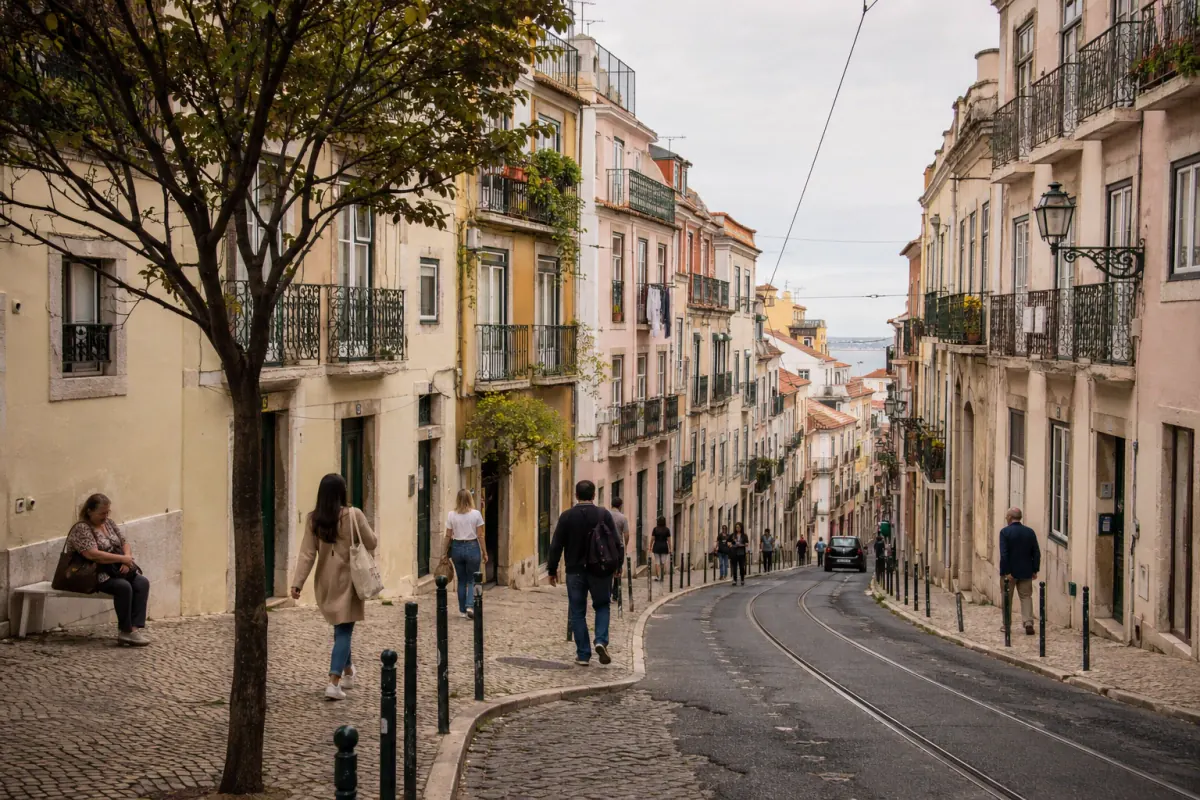
Lisbon remains an attractive European base for remote workers because it combines public transport, walkable daily-life pockets, international connectivity, a mature coworking ecosystem, and a mild Atlantic climate. For anyone evaluating digital nomad Lisbon as a long-stay option, the city offers more institutional depth than a purely lifestyle-oriented destination: Metro, Carris, CP trains, healthcare, universities, business services, and an international airport all support ordinary life beyond a short visit. The important reality is housing. Lisbon’s reputation was partly built on being an accessible Western European capital, but rent pressure and limited supply have changed the calculation. Central apartments are competitive, furnished medium-term housing is expensive, and older buildings may trade charm for damp or weak insulation. The budget and neighborhood choice need to be realistic.
Sponsored
Connect with other digital nomads for friendship, conversation, or companionship.
Lisbon offers several different dating rhythms within a compact but hilly city. Príncipe Real and São Sebastião can work for people who want central cafés, restaurants, and easy access to other neighborhoods. Estrela and Lapa provide a more residential routine with parks, traditional streets, and quieter evening options. Intendente and Anjos have a more mixed, international atmosphere, while Alcântara and the LX Factory area offer work, food, and event settings that can create natural conversation. The useful question is where your workday, housing, and regular social activities overlap.
Build opportunities for repeated contact through coworking spaces, language exchanges, climbing or fitness classes, creative workshops, and professional events. A walk through Jardim da Estrela, a coffee near Príncipe Real, or an early evening around LX Factory can be easier for a second meeting than a formal dinner across town. Lisbon’s public transport helps, but hills, late schedules, and housing distance still shape how often people can meet. If you are looking for a relationship-minded dating service as another channel, a relationship-focused dating service can sit alongside local communities.
Before making plans, confirm current opening hours, event schedules, transport conditions, and any venue rules directly. A place that works for a daytime introduction may not suit a late return or a busy workday. Keep first meetings public, tell a friend where you are going, and let consistency build naturally.
Lisbon also makes future plans worth discussing early. A short-term visitor, a person waiting on a visa decision, and someone building a year-round base may all enjoy the same neighborhood while wanting different kinds of continuity. Ask about expected stay length, work location, travel frequency, and whether housing costs could change the plan. The digital nomad dating guide covers the wider questions that help a promising connection fit into real mobile life.
| Factor | Assessment |
|---|---|
| Cost | Moderate to high for a European long-stay base; housing is the main pressure point |
| Internet | Strong national connectivity context; apartment quality and service setup remain property-specific |
| Coworking | Mature and varied, from flexible community spaces to professional serviced workspaces |
| Community | Large, international, and professionally diverse; social access is easy but dispersed |
| Getting around | Strong public transport and walkable pockets, offset by hills, stairs, cobblestones, and transfers |
| Long-stay suitability | Good for workers whose housing budget, documentation, and terrain expectations match current conditions |
| Best for | European city life, public-transport users, remote teams, freelancers, and internationally minded workers |
| Main drawback | Housing-cost pressure combined with older building stock and central tourism pressure |
These are qualitative judgments, not numerical scores, reflecting how Lisbon typically functions for someone working remotely for several weeks or longer.
Lisbon’s strongest advantage is the combination of city infrastructure and manageable scale. Many residents can organize daily life around walking and public transport rather than a car. A monthly Navegante pass connects Metro and Carris, while CP trains extend the useful radius.
The city also has a mature remote-work ecosystem. Coworking spaces serve freelancers, startups, remote employees, and distributed teams, while cafés and neighborhood workspaces provide variety. That ecosystem is more established than the city’s affordability reputation now suggests: a reliable desk is easy to find, but it is usually a paid line in the monthly budget.
Lisbon’s international community is another draw. Professional events, language exchanges, coworking gatherings, and creative meetups make arrival easier. Deeper local integration still requires routines beyond the expat layer.
The climate is helpful for daily life. Summers are generally warm and dry, while winters are milder than in many continental European capitals. Poorly insulated apartments can still be hot in summer, damp in winter, and expensive to heat or cool.
Lisbon costs are best understood as a housing decision rather than one reliable “digital nomad average.” Rent, contract length, furnishing, utilities, building condition, and distance from transit can change the monthly calculation more than food or local transport.
Lisbon City Council describes a shortage of public and private housing and says rents rose 64% in the last decade while incomes grew 22%. The municipality’s 2023–2032 Housing Charter and current investment programs show that affordability is an active policy problem, not just a complaint from visitors.
Neighborhood guides can provide directional context, but current rents depend on the exact listing, property condition, furnishing, and contract length. Check current listings rather than reusing fixed neighborhood ranges.
Short or medium-term furnished housing can cost more than a standard long-term lease. A landlord may require a deposit, documentation, a Portuguese tax number, proof of income, or several months upfront. Shared housing can lower the monthly figure, but it changes privacy and work conditions. A modern apartment may cost more while solving insulation, elevator, desk, and internet problems that are common in older stock.
Food can be controlled through supermarkets, local cafés, and Portuguese daily routines, but international restaurants, specialty coffee, fitness, and coworking add up. The official metropolitan transit pass is relatively manageable: the 2026 Navegante Municipal is €30 per month and the Metropolitan pass €40, subject to validity and eligibility.
The honest conclusion is balanced: Lisbon is not accurately described as a cheap European nomad base, but it can still be workable for people sharing housing, earning in a stronger currency, living outside the highest-pressure center, or paying for a compact routine that reduces transport time. Affordability is now conditional, not automatic.
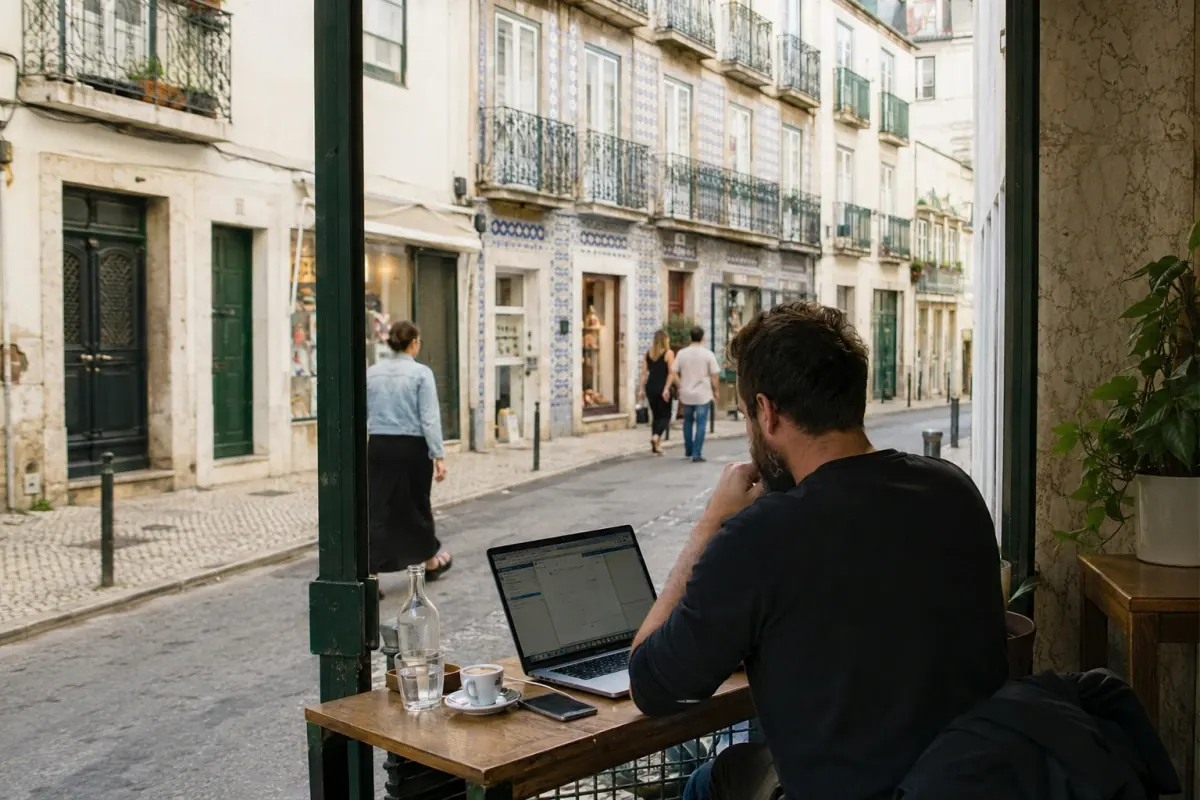
Lisbon neighborhoods differ sharply in terrain, housing stock, transit, noise, tourist pressure, and access to coworking. The best area is usually the one that makes your actual workweek easy, not the one with the strongest online reputation.
Príncipe Real is central, polished, and close to cafés, coworking, restaurants, parks, and the historic core. It is a practical first base for someone who wants social access and many daily errands within walking distance. The area also fits workers who prefer a neighborhood with a visible international presence.
The trade-off is price and competition. Tourist activity, hills, and street noise can accompany the central address. Choose Príncipe Real when centrality matters more than maximizing housing value.
Estrela and Lapa offer a more residential rhythm, leafy public spaces, traditional housing, and a calmer feel than the busiest historic core. They can work well for a longer stay, couples, focused workers, and people who want central access without living directly in the most tourist-heavy streets.
The area’s practical limitation is terrain and transit access. Some streets are steep, and parts of Lapa are not immediately beside a Metro station. Older apartments may have limited heating or weak insulation. Estrela/Lapa suits residents who accept a more deliberate commute.
Arroios is dense, diverse, central, and connected to Metro lines. It has a broad food and service ecosystem and can offer stronger value potential than premium central districts. It often suits independent workers who want local errands, international food, and transit access without paying entirely for a polished historic address.
Conditions vary street by street. Noise, construction, density, and older housing stock can be noticeable. Arroios suits someone who values practical connectivity over a highly curated environment.
Alcântara combines waterfront access, creative and business activity, coworking, renovated industrial spaces, and rail or bus connections. It can suit freelancers, remote teams, and workers who want larger spaces or west-side access without living in the central historic core.
The exact address matters more here than the neighborhood label. Some areas are less consistently walkable, and a resident may depend on bus or rail connections for central trips. Busy roads, industrial edges, and event-related activity can affect noise. Alcântara works when the workspace and transport route are chosen together.
Parque das Nações is modern, planned, flatter, and close to Oriente station and the airport. Newer apartments, professional amenities, and predictable building infrastructure make it attractive to workers who are tired of old central housing. Avila Spaces also operates a coworking location near Oriente.
The trade-off is social and spatial distance from historic Lisbon. The area can feel less organic and less connected to central neighborhood life, even though transport is strong. Choose it when modern construction, flat routes, airport access, and apartment quality matter more than being in the middle of Lisbon’s international social scene.
Choose Príncipe Real for centrality and social convenience, Estrela/Lapa for residential calm, Arroios for transit and relative value, Alcântara for creative/workspace access, and Parque das Nações for modern housing and flat, airport-connected practicality. Before committing, inspect the exact street, test the route at commute time, and ask about heating, cooling, internet, sound insulation, elevator access, and utility caps.
Portugal has mature fixed and mobile connectivity, and Lisbon apartments and coworking spaces commonly advertise fiber or high-speed broadband. A national or regional median should not be treated as a guarantee for one apartment: building wiring, router placement, service activation, and whether the connection belongs to the landlord or tenant matter more to daily work.
Accommodation testing is essential. Ask whether fiber is active, whether the router is inside the apartment, how the connection performs on video calls, and whether mobile tethering is possible. Older apartments may have a good provider available but a poor installation or weak internal setup. Coworking spaces generally provide more predictable call conditions than cafés.
Lisbon supports remote work well when the work setup is treated as part of the housing decision. A cheaper apartment with a difficult desk, poor sound insulation, and an unreliable connection may cost less on paper while making the long stay harder.
Lisbon’s coworking market is mature and tiered. Avila Spaces, Second Home Lisbon, Heden, and LACS serve different neighborhoods and work styles. Locations, hours, membership plans, and prices change, so verify current terms directly before relying on a workspace.
Heden describes a neighborhood-based coworking approach, while LACS serves flexible-office and community demand across Lisbon locations connected with areas such as Alcântara, Santos, and Anjos.
Cafés are useful for changing scenery, but laptop policies, sockets, noise, table turnover, and call suitability vary. A paid coworking desk is often the more reliable solution, but it adds a meaningful recurring cost. The strongest neighborhood is therefore the one that keeps your selected workspace and home within a simple transit or walking routine.
Public transport is one of Lisbon’s clearest long-stay advantages. Metro and Carris form the everyday backbone, with CP trains and other metropolitan operators filling longer routes. The Navegante system makes monthly planning relatively straightforward, although the exact pass depends on whether you need municipal or metropolitan coverage.
Metro service generally runs from around 06:30 until 01:00, and contactless bank-card payment is available alongside Navegante options. The network is useful, but transfers, crowded vehicles, and last-mile hills still shape the daily experience.
Lisbon is walkable in pockets, not uniformly easy on foot. Hills, stairs, cobblestones, narrow pavements, heat, rain, and accessibility barriers make a route feel different from a map distance. Príncipe Real and Estrela/Lapa can place errands close while demanding effort on the slope. Arroios and Parque das Nações offer flatter routes in many sections, while Alcântara depends heavily on the exact connection to rail or bus.
The best home base often reduces transfers and terrain rather than maximizing proximity to a famous center.
Lisbon’s international community is large and professionally varied. Coworking events, startup networks, language exchanges, creative meetups, professional groups, and expat communities provide repeated entry points. Nomads.com provides platform visibility and behavioral signals, but its reviews, estimates, and visitor figures are not official population statistics.
Social access is easiest through repetition. One coworking space, class, language exchange, or neighborhood routine can create more durable contact than moving between highly visible events. Central areas have greater event density, but Arroios, Alcântara, and Parque das Nações can support their own professional and residential networks.
The international environment helps newcomers, but Portuguese language effort and repeated neighborhood contact matter for residents who want more than a temporary base. For a relationship-focused guide, read dating in Lisbon as a digital nomad.
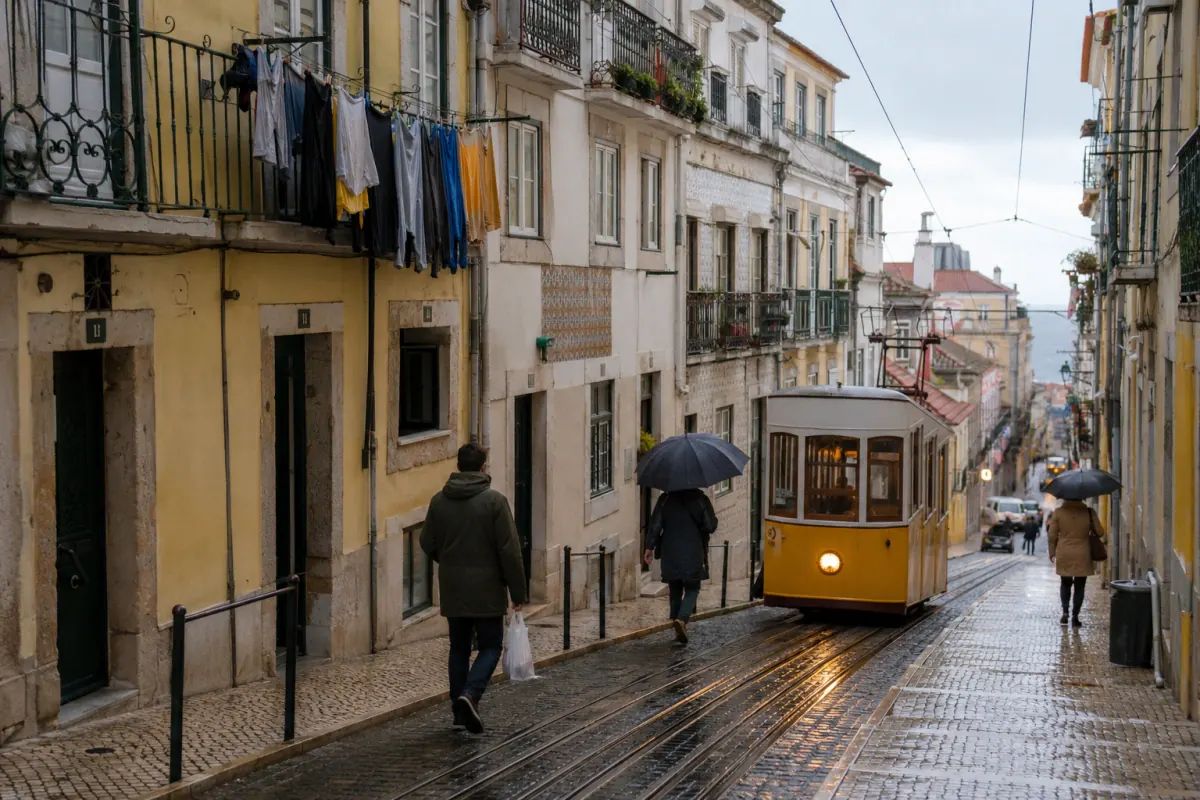
Lisbon supports ordinary routines: supermarkets, pharmacies, gyms, markets, healthcare, delivery services, parks, cafés, and professional services are available across the main residential areas.
Housing quality is the main variable. Older apartments may have character but also damp, poor insulation, limited heating, small lifts, street noise, or no practical desk. Newer units, especially around Parque das Nações and redeveloped areas, may solve some of those problems at a higher rent.
Inspect heating and cooling, internet activation, sound insulation, elevator access, desk space, laundry, and utility caps. Lisbon’s mild climate does not remove the need for heating in winter or cooling during hot periods. Daily comfort depends more on the specific building than on the city’s climate label.
Lisbon is generally manageable with normal urban awareness, but a long-stay resident should think beyond headline safety. Tourist-heavy areas require care with belongings, while hills, cobblestones, stairs, tram corridors, and wet surfaces create practical mobility risks. Nighttime noise can also be a housing issue in central districts.
Apartment inspection matters. Confirm locks, heating, damp, mold, hot water, internet, elevator operation, construction nearby, and the route to groceries and transit. A video viewing may not reveal street noise, poor insulation, or the slope outside the building.
Portugal’s immigration, tax, and residence rules can change. The remote-work residence pathway is useful context, not personal legal advice. Verify current requirements through AIMA, consular, and Portuguese government sources before making plans.
Lisbon has a mild Atlantic climate with warm, generally dry summers and cooler, wetter winters. IPMA is the preferred authority for current climate and seasonal data.
The climate supports outdoor routines for much of the year, but “mild” does not mean uniform indoor comfort. Summer heat can expose weak insulation and increase cooling costs. Winter damp and cool interiors can make remote work unpleasant in older apartments, even when outdoor temperatures are moderate.
Spring and autumn often provide a balanced long-stay combination of outdoor conditions and less intense seasonal pressure. Summer offers reliable dry weather but can bring stronger visitor demand and higher central housing pressure. Winter may be quieter, but apartment heating, damp, laundry drying, and rainy commutes deserve closer attention.
Portugal has a formal remote-work residence pathway for eligible non-EU applicants. AIMA describes residence authorization for remote professional activity performed for entities outside Portugal and lists documentation requirements including a valid residence visa and proof of employment or service relationships. Our Portugal remote-work residence guide explains the route without treating “D8” as its formal legal name.
This helps explain Lisbon’s European long-stay appeal, but it should not turn the destination page into a visa guide. Income thresholds, appointments, documentation, tax residence, and processing practice can change. Global Citizen Solutions may provide country-level context, but AIMA, consular, and government sources take priority.
The practical conclusion is mixed: Lisbon offers a credible legal and infrastructure context for a European long stay, but housing cost and housing availability can be the limiting factor. Documentation does not solve the affordability problem.
A two- to four-week trial is useful for testing neighborhood, housing quality, terrain, coworking, and transit before signing a longer agreement. This is especially sensible in Lisbon because an apartment can look central and attractive while being damp, noisy, poorly insulated, or difficult to reach on foot.
One month is enough to establish a routine around a workspace, grocery route, gym, and social group. Stays of three to six months are practical for residents who can secure suitable housing and absorb deposits, utilities, coworking, and transport costs. Longer stays benefit from a local address, stable routines, and a neighborhood selected around daily work rather than initial tourism appeal.
Lisbon suits long stays best when the resident accepts that “central” and “comfortable” may require different budgets. Arroios or Alcântara may offer a practical compromise; Parque das Nações may solve building quality; Estrela/Lapa may solve residential pace; Príncipe Real may solve social access at a higher price.
Choose one or two recurring routines rather than relying on one-off events. Coworking spaces, language exchanges, classes, professional meetups, and neighborhood groups create repeated contact. Central districts are convenient, but the best social routine is usually the one close enough to attend consistently.
Lisbon’s international character makes introductions relatively easy. Durable connection still requires showing up, learning some Portuguese, and building relationships beyond the most visible expat venues. For a broader framework on building connections as a remote worker, see our guide to connections for digital nomads.
For a European city comparison, Barcelona shares Lisbon's housing pressure, walkable districts, and international work scene. For a slower Southeast Asian long-stay profile, Chiang Mai offers a mature coworking ecosystem and a major seasonal air-quality trade-off. Bangkok offers denser capital-city infrastructure, rail transit, and a larger urban service base. Canggu offers a beach-oriented, scooter-dependent lifestyle with strong coworking culture and a different housing and infrastructure trade-off. For a direct decision view, compare Lisbon vs Barcelona, Canggu vs Lisbon, or Chiang Mai vs Lisbon.
Cost planning, slow travel, and working remotely while traveling are useful lenses for comparing Lisbon's housing and daily-life trade-offs. Read the Remote Work guide for broader work-model and routine guidance.
Lisbon’s strongest advantages are its European infrastructure, public transport, walkable pockets, coworking ecosystem, international community, mild climate, and long-stay context. It suits people who want city life without depending on a car.
The central compromise is affordability. Housing pressure, central tourism, older apartments, hills, and paid coworking mean the city’s current reality is more expensive and conditional than its earlier reputation suggests. A good Lisbon stay depends on choosing a neighborhood and building that match the actual workweek.
If you value public transport, international connectivity, a mild climate, and European city life, and can manage current housing costs, digital nomad Lisbon is worth serious consideration. If low rent, modern housing, quiet streets, or flat terrain are non-negotiable, another base may serve you better. Compare Lisbon with other destinations before making a long-stay decision.
Core sources are listed with their verification dates. Time-sensitive information should be rechecked before acting on it.
Common questions
Lisbon offers public transport, walkable pockets, coworking, international connectivity, and a mild Atlantic climate. Housing cost, limited supply, hills, tourism pressure, and older buildings require realistic planning.
Coworking communities, language exchanges, professional events, classes, neighborhood cafés, creative spaces, and recurring activities can help remote workers build social continuity.
Public transport and walkable neighborhoods make car-free living possible for many residents. Hills, stairs, cobblestones, transfers, and where you live still have a large effect on daily convenience.
Housing is usually the main pressure point. Compare furnished medium-term rent, utilities, transport, coworking, food, and the distance between your accommodation and the routines you expect to use.